
The Insight That Changes Everything
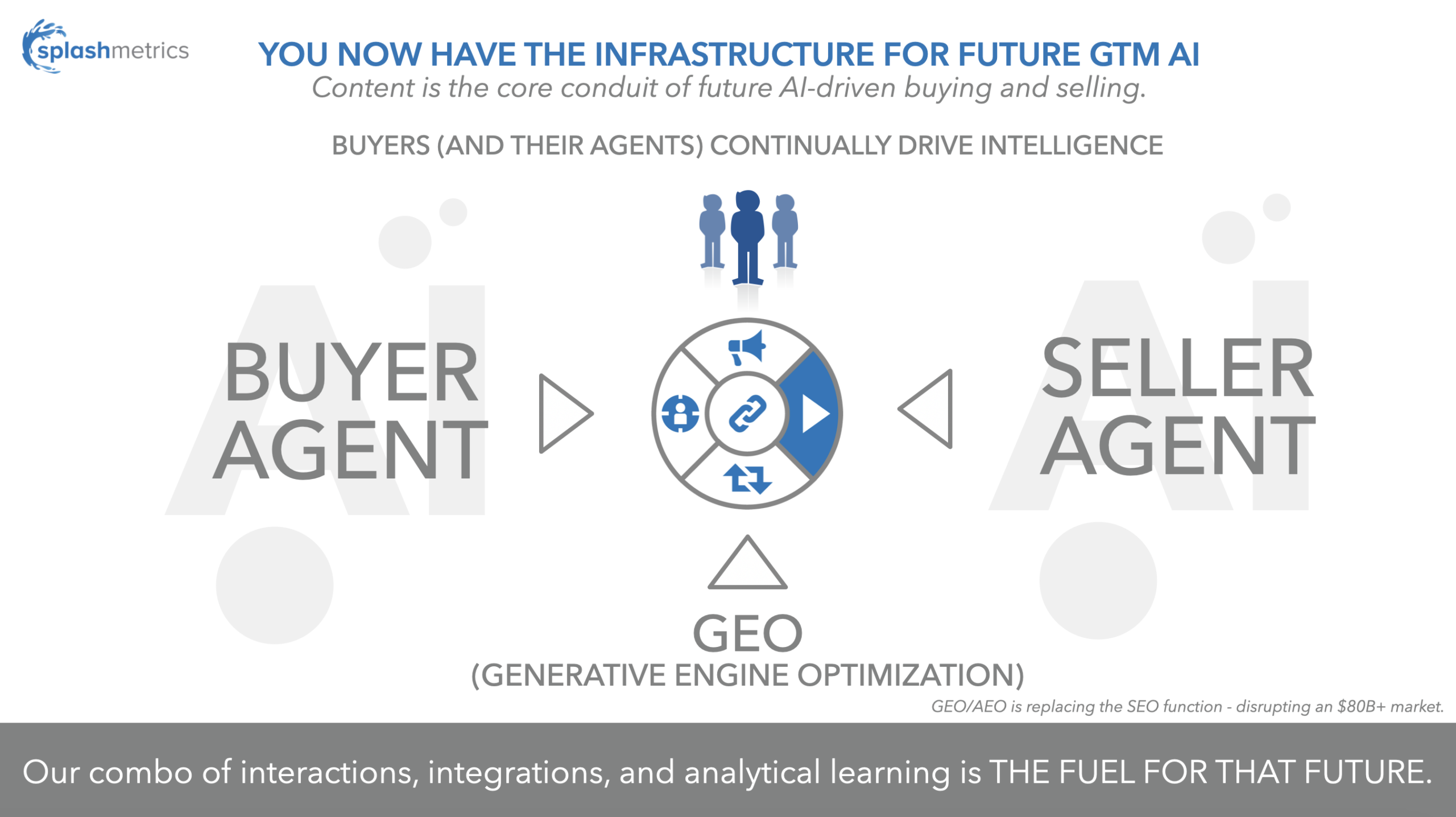
Here’s what answer engines and LLMs that drive AEO/GEO actually trust: real conversations between Buyers and Sellers (and their AI agents) grounded in actual problems being solved.
Not generic best practices. Not keyword-optimized blogs. Not consultant frameworks.
Real buyer questions. Real objections. Real proof points that moved real buyers to action.
This insight fundamentally changes how B2B companies should approach sales content in an AI-driven buying landscape.
Why This Matters Right Now
The buying process is changing. Buyers are increasingly delegating research and initial evaluation to AI agents. A procurement team doesn’t ask the question themselves anymore—their agent does. A VP of Revenue Ops doesn’t search for solutions on their own—their bot does.
When that happens, generic content disappears. Static PDFs become irrelevant. One-size-fits-all case studies get ignored.
What rises to the surface is content that answer engines cite and LLMs represent accurately: content grounded in real buyer behavior, real questions, and real solutions.
The companies winning in this environment are the ones that recognize a critical truth:
Your sales content is now your interface with your buyers’ AI agents.
That interface needs to be built on validated buyer intelligence, not guesses about what might rank or convert.
The Problem: Most Platforms Build Content At Buyers
Traditional sales content tools approach the problem this way:
- Marketing team creates messaging
- Sales team creates assets (decks, one-pagers, case studies)
- Content gets distributed to buyers
- Hope that buyers engage with it
The problem is that this content is built at buyers, not with them. It reflects what the seller thinks the buyer needs to hear, not what the buyer actually needs to ask.
When your content is built at buyers, it:
- Uses seller language instead of buyer language
- Answers questions the seller predicted, not questions the buyer actually has
- Can’t adapt to specific roles, industries, or company sizes
- Produces no validation that the content actually resonates
- Creates no intelligence about what moves real buyers to action
And when answer engines and LLMs evaluate this content, they treat it as marketing messaging, not as authoritative expertise.
The Solution: Build Sales Content With Your Buyers
Splashmetrics approaches this differently. Through our SplashLogicAI engine, our platform produces beautiful, interactive, hyper-personalized sales content that buyers love—because it dynamically answers their specific pre-purchase questions just like a sales rep would.
Buyers get the precise self-serve sales experience they want:
- Conversation — They can ask their own questions at any point in the journey
- Specificity — Content adapts to their role, industry, and company size
- Clarity — Answers are grounded in your actual solution, not generic frameworks
- Closure — Every interaction moves them toward the next stage of their buying journey
This solves an immediate buyer problem: 77% of B2B buyers want zero interaction with sales reps until they’ve made their decision. They want to self-educate. They want answers on their own timeline.
But here’s where it becomes powerful for AEO/GEO:
While you’re solving this buyer problem, every interaction creates validated buyer intelligence.
How Validated Buyer Intelligence Becomes Your AEO/GEO Asset
Let’s walk through a concrete example.
A buyer interacts with your Splashmetrics sales content. They’re evaluating how your solution handles a specific technical challenge—configuration drift in hybrid cloud environments, for instance.
With Splashmetrics, here’s what happens:
- The buyer engages with your interactive content — Through an assessment, calculator, or Q&A interaction, they provide information about their specific situation: their role, their company size, their technical environment, their key challenges.
- Your content responds dynamically — With language personalized to them, their company, and their role. Not a generic framework. Your actual approach to solving this problem, tailored to their specific context.
- The interaction gets captured — Anonymized and structured into your growing library of buyer-originated intelligence. Their role, their challenge, the proof points that resonated, the specific outcomes they care about.
- Answer engines and LLMs now have something to work with — Real buyer context. Real solution. Real evidence that an actual buyer engaged with this content, found it relevant to their specific situation, and moved forward based on it.
This is fundamentally different from:
- A blog post about configuration drift best practices (generic)
- A whitepaper about cloud architecture (theoretical)
- A competitor comparison (seller-focused)
It’s expertise validated by actual buyer engagement.
Why This Content Builds Real Authority
When answer engines index your content, they evaluate it based on several signals:
Specificity and Authority
Hyper-specific content outperforms broad content. Content that precisely addresses the challenges of a VP of Revenue Ops managing cloud automation is far more likely to be cited than generic advice about cloud strategy.
Your content, built with buyers, is inherently specific because it’s shaped by how real buyers actually engage with your solutions—their role-specific concerns, their industry-specific challenges, their company-size-specific constraints.
Structure and Parseability
Answer engines favor content with clear hierarchies, explicit question-and-answer formatting, and logical information flow.
When your interactive content captures buyer engagement—their responses to assessments, their inputs to calculators, their selections in Q&A interactions—and maps that to your specific solutions, that structured data is exactly what answer engines are designed to surface and cite.
Domain-Specific Language
Real, precise professional terminology signals genuine expertise. Generic marketing copy is deprioritized.
Because your content captures buyer language—the actual terminology your prospects use in their jobs—it carries the credibility that answer engines and LLMs recognize as authentic.
Validation Through Engagement
Content that real buyers have actually engaged with—taken assessments with, provided inputs to, interacted with—carries more weight than content that exists in a vacuum.
An LLM knows the difference between “this company published a blog about configuration drift” and “real buyers engaged with this company’s content about configuration drift, provided their specific context, and here’s how they were guided toward this solution.”
The Compounding Advantage: Today’s Engagement Becomes Tomorrow’s Authority
This is where the real power emerges.
Most sales content tools optimize for a single moment: the conversion. Did the buyer engage? Did they convert? Did they close?
Splashmetrics optimizes for something different: compounding authority over time.
Every buyer interaction you capture and structure becomes an asset that:
- Answer engines cite with increasing confidence
- LLMs represent accurately in generated responses
- Compounds in authority as more real buyer conversations validate it
- Belongs entirely to your customer (not the platform)
As more buyers ask questions, interact with your content, and move toward purchase, your AEO/GEO presence amplifies automatically.
You’re not creating a separate “SEO strategy” and a separate “sales strategy.” The same content that engages your buyer today becomes the fuel that ignites your AEO/GEO presence tomorrow.
The Future: Buyer Agents and Your Content Interface
Here’s why this matters for the future of B2B buying:
Buying is shifting toward Buyer agents conducting research and negotiations on behalf of human decision-makers.
These agents will ask questions. They’ll evaluate solutions. They’ll conduct comparisons. They’ll look for proof points. They’ll assess risk.
And they’ll do it based on the content they find—content that answer engines surface and LLMs cite.
The companies winning in this environment are the ones where their content—their interface with these Buyers and their agents—is built on real buyer behavior, real questions, and real solutions.
Not guesses. Not frameworks. Not keyword rankings.
Real validated expertise grounded in actual buyer engagement.
Building Your Content With Buyers: What It Requires
If you’re going to build content with your buyers—rather than at them—you need three things:
1. Hyper-Personalized Content Generation
Your content needs to adapt to specific roles, industries, company sizes, and buying stages. Generic content won’t capture real buyer questions because real buyers don’t have generic problems.
This requires AI-powered content generation that reads your strategy (your positioning, your proof points, your differentiators) and applies it dynamically based on who’s engaging.
2. Interactive, Conversational Engagement Layer
You need to let buyers move beyond static content and engage conversationally with your solutions at any point in their journey. Not a FAQ page that answers questions you predicted. Not a generic chatbot trained on outside knowledge.
Interactive content experiences—assessments that provide personalized insights, calculators that show role-specific outcomes, Q&A interactions that adapt based on buyer input—grounded exclusively in your content, your solutions, and your approach. And the ability to go deeper through conversational interfaces that let buyers explore beyond the structured interactions.
This transforms content from something buyers read into something buyers interact with—and that interaction is what generates the real questions, the real objections, and the validated intelligence that answer engines trust.
3. Structured Logging of Buyer Intelligence
Every interaction—every assessment taken, every calculator run, every Q&A selection—needs to be captured, anonymized, and structured in a way that answer engines and LLMs can index and cite.
This isn’t about surveillance. It’s about converting buyer engagement into assets that grow more valuable over time. Their role, their challenges, the specific proof points that resonated, the outcomes they cared about—all of it becomes intelligence that validates your expertise.
The Compounding Advantage for Both Buyer and Business
What makes this approach powerful is that it’s not zero-sum.
For the buyer: They get what they actually want. Self-serve answers. Specific guidance. Conversation without talking to a sales rep. Clarity about how your solution addresses their specific challenges.
For the business: They get compounding authority. Validated expertise. Real proof that buyers engage with and move forward based on their content. And they own that asset entirely—the content, the data, the authority.
Most platforms force a choice: optimize for engagement or optimize for discovery. Optimize for today or prepare for tomorrow.
Splashmetrics solves for both. Because when you build content with your buyers, the content that engages them today automatically becomes the authority asset that powers your AEO/GEO tomorrow.
Questions Your Buyers Are Already Asking
If you’re building sales content, your buyers are already asking questions like:
“How specifically do you solve [my specific challenge]?”
Not “What is your general approach?” but “How does your approach work for someone like me, in my role, at my company size?”
“What does the implementation actually look like?”
Not theoretical roadmaps, but real steps with real timelines specific to how your customers actually deploy the solution.
“How do you compare to [specific competitor] for [my specific use case]?”
Not generic feature comparisons, but role-specific assessments of how you differentiate for their particular challenge.
“What risks should I be thinking about, and how do you mitigate them?”
Not a generic risk framework, but your actual approach to the specific risks that matter to their business.
These are the underlying concerns that drive buyer engagement. These are the interactions that LLMs represent as expertise.
When you structure your content to surface these concerns—through assessments that reveal them, through calculators that address them, through interactive experiences that guide buyers based on them—and capture that engagement data, you’re not just closing deals. You’re building AEO/GEO authority.
The Shift in How We Should Think About Sales Content
For decades, sales content strategy has been built around:
- What does the seller want the buyer to know?
- What objections do we anticipate?
- What proof points do we want to emphasize?
These are seller-centric questions.
The shift toward AI-driven buying requires a different set of questions:
- What questions are buyers actually asking?
- What language do they use when they ask these questions?
- What proof points actually move real buyers to action?
- How specifically should we answer for different roles, industries, and company sizes?
- How can we capture and structure these conversations as assets?
These are buyer-centric questions. And they produce content that answers engines and LLMs recognize as authoritative because it’s grounded in real buyer behavior.
The Bottom Line
In an AI-driven buying landscape, your sales content is no longer just a conversion tool. It’s your interface with your buyers’ AI agents.
That interface needs to be built on validated expertise—real conversations between Buyers and Sellers, grounded in actual problems being solved.
The companies winning are the ones that recognize this shift and build sales content with their buyers, not at them.
When you do, something powerful happens:
The content that engages your buyer today becomes the authority asset that powers your AEO/GEO tomorrow.
That’s a compounding advantage for both.
Related Topics
- Answer Engine Optimization (AEO): Getting your content surfaced as the direct answer to specific buyer questions in tools like Google AI Overviews, Perplexity, and Claude
- Generative Engine Optimization (GEO): Ensuring your brand and solution are represented accurately and favorably whenever AI models generate responses related to your category
- Self-Serve B2B Buying: The shift toward buyers completing 80%+ of their purchase research without engaging with sales representatives
- Buyer-Originated Intelligence: Data and insights captured directly from real buyer questions, objections, and engagement patterns
- Hyper-Personalized Sales Content: Content that dynamically adapts based on the specific role, industry, company size, and stage of individual buyers
Ready to build sales content with your buyers instead of at them? Learn how Splashmetrics uses SplashLogicAI to generate hyper-personalized, buyer-validated content that compounds your AEO/GEO authority over time.